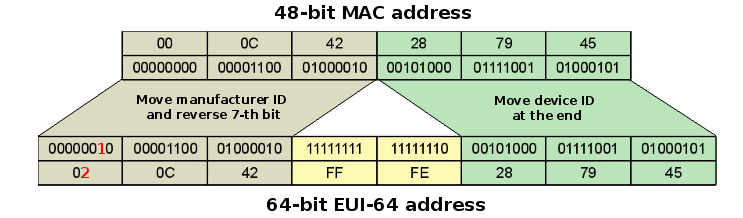
Convert MAC address to Link-local address or Link-local address to MAC address. The IPv6 Link-local address is derived form the MAC- or Ethernet hardware address in the following way; Mac address: XX:XX:XX:XX:XX:XX: IPv6 Link local address: fe80::xyxx:xxff:fexx:xxxx: Where y = X XOR 2. Furthermore 'ff:fe' is inserted and 'fe80::' prepended. Call of duty fake. EUI-64 (Extended Unique Identifier) is a method we can use to automatically configure IPv6 host addresses. An IPv6 device will use the MAC address of its interface to generate a unique 64-bit interface ID. However, a MAC address is 48 bit and the interface ID.
Description
Date
Source
Own work
Author
Mro
Licensing
I, the copyright holder of this work, hereby publish it under the following licenses:
Permission is granted to copy, distribute and/or modify this document under the terms of the GNU Free Documentation License, Version 1.2 or any later version published by the Free Software Foundation; with no Invariant Sections, no Front-Cover Texts, and no Back-Cover Texts. A copy of the license is included in the section entitled GNU Free Documentation License.
This file is licensed under the Creative Commons Attribution-Share Alike 3.0 Unported, 2.5 Generic, 2.0 Generic and 1.0 Generic license.
You are free:
to share – to copy, distribute and transmit the work
to remix – to adapt the work
Under the following conditions:
attribution – You must give appropriate credit, provide a link to the license, and indicate if changes were made. You may do so in any reasonable manner, but not in any way that suggests the licensor endorses you or your use.
share alike – If you remix, transform, or build upon the material, you must distribute your contributions under the same or compatible license as the original.
Captions
Add a one-line explanation of what this file represents
'}},'text/plain':{'en':{':'creator'}}},'{'value':{'entity-type':'property','numeric-id':4174,'id':'P4174'},'type':'wikibase-entityid'}':{'text/html':{'en':{':'Wikimedia username'}},'text/plain':{'en':{':'Wikimedia username'}}},'{'value':'Mro','type':'string'}':{'text/html':{'en':{'P4174':'Mro','P2093':'Mro'}},'text/plain':{'en':{'P4174':'Mro','P2093':'Mro'}}},'{'value':{'entity-type':'property','numeric-id':2699,'id':'P2699'},'type':'wikibase-entityid'}':{'text/html':{'en':{':'URL'}},'text/plain':{'en':{':'URL'}}},'{'value':'https://commons.wikimedia.org/wiki/user:Mro','type':'string'}':{'text/html':{'en':{'P2699':'https://commons.wikimedia.org/wiki/user:Mro'}},'text/plain':{'en':{'P2699':'https://commons.wikimedia.org/wiki/user:Mro'}}},'{'value':{'entity-type':'property','numeric-id':2093,'id':'P2093'},'type':'wikibase-entityid'}':{'text/html':{'en':{':'author name string'}},'text/plain':{'en':{':'author name string'}}},'{'value':{'entity-type':'property','numeric-id':3831,'id':'P3831'},'type':'wikibase-entityid'}':{'text/html':{'en':{':'object has role'}},'text/plain':{'en':{':'object has role'}}},'{'value':{'entity-type':'item','numeric-id':33231,'id':'Q33231'},'type':'wikibase-entityid'}':{'text/html':{'en':{'P3831':'photographer'}},'text/plain':{'en':{'P3831':'photographer'}}}}'>
'}},'text/plain':{'en':{':'source of file'}}},'{'value':{'entity-type':'item','numeric-id':66458942,'id':'Q66458942'},'type':'wikibase-entityid'}':{'text/html':{'en':{'P7482':'original creation by uploader'}},'text/plain':{'en':{'P7482':'original creation by uploader'}}}}'>
'}},'text/plain':{'en':{':'inception'}}},'{'value':{'time':'+2010-05-23T00:00:00Z','timezone':0,'before':0,'after':0,'precision':11,'calendarmodel':'http://www.wikidata.org/entity/Q1985727'},'type':'time'}':{'text/html':{'en':{'P571':'23 May 2010'}},'text/plain':{'en':{'P571':'23 May 2010'}}}}'>
File history
Click on a date/time to view the file as it appeared at that time.
No pages on the English Wikipedia use this file (pages on other projects are not listed).
Global file usage
The following other wikis use this file:
Usage on fr.wikipedia.org
Usage on fr.wikibooks.org
Usage on ro.wikipedia.org
Retrieved from 'https://en.wikipedia.org/wiki/File:Ipv6_eui64.svg'
One of IPv6's key benefits over IPv4 is its capability for automatic interface addressing. By implementing the IEEE's 64-bit Extended Unique Identifier (EUI-64) format, a host can automatically assign itself a unique 64-bit IPv6 interface identifier without the need for manual configuration or DHCP. This is accomplished on Ethernet interfaces by referencing the already unique 48-bit MAC address, and reformatting that value to match the EUI-64 specification.
RFC 2373 dictates the conversion process, which can be described as having two steps. The first step is to convert the 48-bit MAC address to a 64-bit value. To do this, we break the MAC address into its two 24-bit halves: the Organizationally Unique Identifier (OUI) and the NIC specific part. The 16-bit hex value 0xFFFE is then inserted between these two halves to form a 64-bit address.
Why 0xFFFE? As explained in the IEEE's Guidelines for EUI-64 Registration Authority, this is a reserved value which equipment manufacturers cannot include in 'real' EUI-64 address assignments. In other words, any EUI-64 address having 0xFFFE immediately following its OUI portion can be recognized as having been generated from an EUI-48 (or MAC) address.
The second step is to invert the universal/local (U/L) flag (bit 7) in the OUI portion of the address. Globally unique addresses assigned by the IEEE originally have this bit set to zero, indicating global uniqueness. Likewise, locally created addresses, such as those used for virtual interfaces or a MAC address manually configured by an administrator, will have this bit set to one. The U/L bit is inverted when using an EUI-64 address as an IPv6 interface ID.
Again, you're probably wondering why this is done. The answer lies buried in section 2.5.1 of RFC 2373:
The motivation for inverting the 'u' bit when forming the interface identifier is to make it easy for system administrators to hand configure local scope identifiers when hardware tokens are not available. This is expected to be case for serial links, tunnel end-points, etc. The alternative would have been for these to be of the form 0200:0:0:1, 0200:0:0:2, etc., instead of the much simpler ::1, ::2, etc.
The important part to remember here is that the scope of the address never changes: global addresses are still global and local addresses are still local. Rather, the meaning of the bit is inverted for convenience, so the value of the bit must be inverted as well.
We can see this conversion in action when we assign an IPv6 address to a router interface. First, take note of the interface's MAC address (this is typically the same as its burned-in address, or BIA).
After assigning an EUI-64-designated IPv6 address to the interface, we can verify that the interface ID has been drawn from the MAC address in the process described for both the assigned and the link local address:
FFFE in the middle of the MAC address of the network card. Also, the 7th bit in the first byte is flipped to a binary 1. The interface ID created this way is known as the modified extended unique identifier 64 (EUI-64).





/image%2F6307157%2F20210327%2Fob_def259_mp4-to-webm-handbrake.jpeg)
/image%2F6307157%2F20210327%2Fob_5cda5d_convert-to-prores-422-mpeg-streamclip.png)
/image%2F6307157%2F20210327%2Fob_bdc60a_legacy-of-the-void-hearthstone.jpeg)
/image%2F6307157%2F20210327%2Fob_59116e_voice-mod-league-of-legends.jpeg)